
Sussex County VINE Coverage
The official NJDOC brochure calls the program the New Jersey VINE Service. It supplies custody information and lets a user register for status notifications while a matching offender remains in custody. Access is available through VINELink, its mobile app, 1-877-846-3465, and TTY 1-866-847-1298. The service is free, confidential, and multilingual.
Coverage must be checked record by record. The brochure does not enumerate every participating county facility. For a Sussex matter, confirm that the result names Morris County Correctional Facility or the correct receiving agency. Under the shared-services arrangement, MCCF physically houses Sussex adult commitments. Keogh-Dwyer remains the Sussex command and transport base, not the ordinary release gate.
A state-prison record should be checked against NJDOC. Federal sentenced custody belongs in the Bureau of Prisons locator, while federal pretrial custody may be held for the U.S. Marshals Service without a public USMS name search. ICE has its own locator. VINE should not be stretched across systems it does not document.
The system is most useful when the custody record is active. A user can check status once, then register to learn of a later agency-reported change. The alert does not identify the full legal basis for release. A Sussex court dismissal, a sentence to time served, parole, a state transfer, or an outside detainer may all produce a movement that needs another official record to explain it.
Juvenile matters are outside the adult workflow. Sussex youth may be housed through the Morris County Juvenile Detention Center shared-service arrangement, but identity, placement, photo, and release information is generally protected. Authorized family, counsel, the Family Division, and juvenile-services contacts are the proper channels rather than an adult VINE search process.
Search Sussex County VINE Records
Use exact identity information and inspect the reporting source before drawing a conclusion. Similar names are common. A result connected to another county, NJDOC, or a different birth detail may not be the intended person. If the Sussex arrest is known but no state sentence is known, Morris custody and the Sussex court case are the key checks beside VINE.
- Open VINELink and select New Jersey.
- Choose the offender search function rather than a general web search.
- Enter the exact name or identifier offered by the interface. Retry known aliases or spellings when needed.
- Compare every available identifier, not just the displayed name.
- Verify the reporting facility or agency. For a Sussex county commitment, look for MCCF or the correct later custodian.
- Open the matching record and read the custody status in its own terms.
- Preserve the event wording, agency, and alert time if a release or status-change notice arrives.
If several records look plausible, stop and compare the booking number, SBI number, case data, and known dates. A state SBI number is especially useful when matching NJDOC history. The Sussex County release verification path adds the court and custodian records needed to settle an uncertain match.
A no-result at this stage should trigger a source check, not a conclusion. Ask whether VINE ever covered the custody episode and whether the search used the physical housing agency. Sussex's correctional name can steer a search toward Newton even though adult housing is in Morristown. If the person was sentenced into state custody, continue with NJDOC instead of repeating county-only searches.
Note: A same-name result from the wrong reporting agency is not evidence about the Sussex County custody episode.
Sussex County VINE Release Fields
VINE is a notification layer. Its value is a timely view of the status an agency reports and a way to receive a change notice. It does not replace the jail's movement or release record. That documentary record can show the administrative exit time, disposition, and destination needed to distinguish a community release from a transfer.
| VINE element | What it supports | What it cannot prove alone |
|---|---|---|
| Name or ID | Matching the reported custody record | Identity without comparison to other details |
| Reporting agency or facility | Which custodian supplied the status | Every earlier or later custodian |
| Custody status | The agency's current reported state | A permanent historical release record |
| Release or status-change alert | A timely event reported by that agency | Release to the community rather than transfer |
| Alert options | Available registration channels for a searchable record | Retroactive registration after the record disappears |
When an alert says released, save the exact wording and time. Then search the Morris/Sussex court case for the legal basis and request the custodian's release record. If a detainer controlled, one agency may report release while another takes custody. A state transfer leads to NJDOC. A federal or immigration handoff leads to the matching federal system.
Evidence should be ranked by the question it answers. The releasing agency's movement record is strongest for the physical exit and destination. A VINE alert tied to that agency is a useful, timely report. NJDOC Date Out-of-Custody or a BOP release date supports a retrospective state or federal exit. A court order can authorize release without showing when jail processing ended. Mere absence from a current search is the weakest clue.
The official VINELink interface is shown below as captured for Sussex County release research.
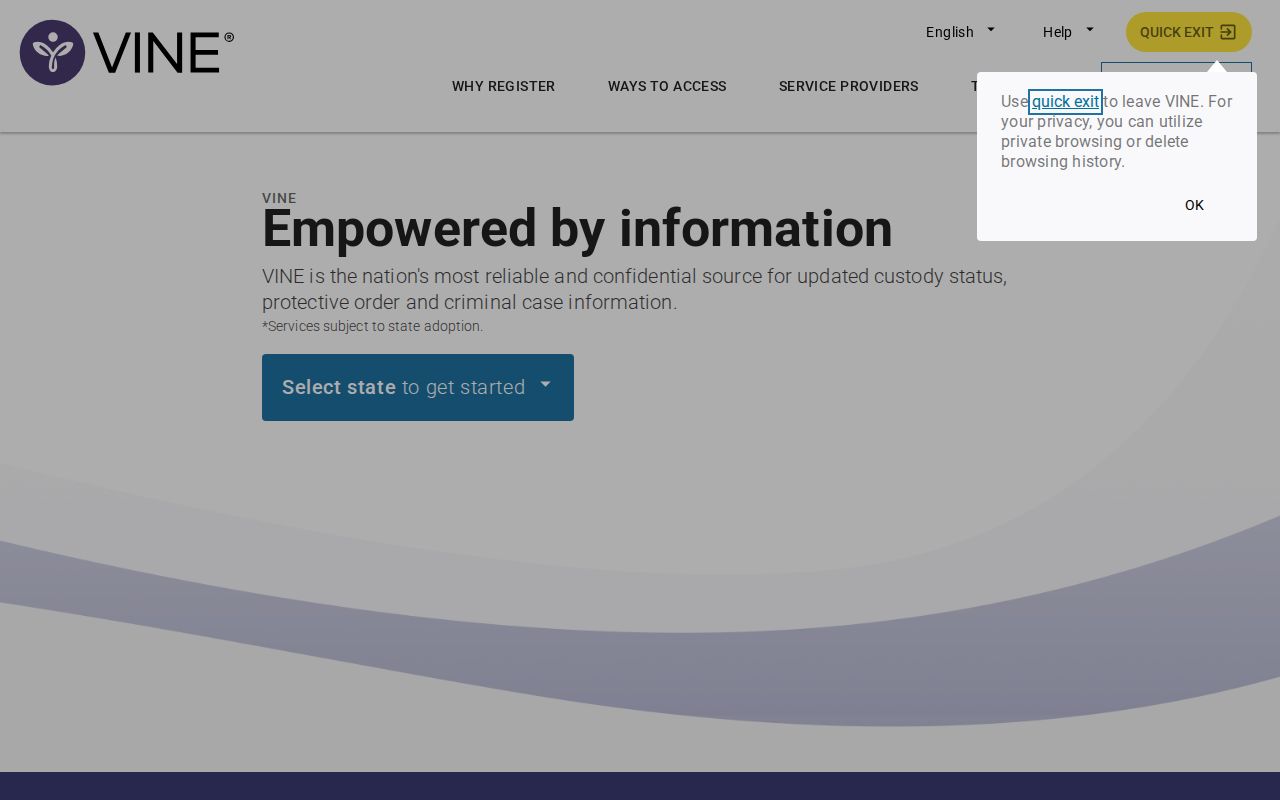
The screen is a starting point for one record, while the named custodian remains the source of the final movement document.
Register Sussex County Release Alerts
Register before release. The official New Jersey brochure conditions registration on the offender being in custody. Once a matching record has aged out or vanished, retroactive enrollment may not be available. Advance registration is therefore most useful when the person is still shown under MCCF, NJDOC, or another reporting agency.
- Open the verified matching record while it remains searchable.
- Select the notification option and choose phone, text, app, email, or TTY as offered.
- Enter the destination accurately. For registration tied to a phone number, create the four-digit PIN used to confirm receipt.
- Complete the confirmation process for that channel.
- Register again for each extra delivery method. The brochure requires a separate registration for each type.
- Keep agency and record identifiers with the registration so a later alert can be traced to its source.
A phone PIN is part of receipt confirmation; it is not a custody identifier and should not be confused with an SBI or booking number. Registering both phone and email means completing each path separately. Users who need help can contact New Jersey VINE by phone or TTY.
Notifications can arrive after the underlying event because agency reporting and delivery take time. The alert is still useful, but its transmission time should not be rewritten as the actual jail-door exit time.
If the person is no longer searchable before registration is complete, call VINE or the last custodian. Do not create a registration against a similar name simply to keep receiving alerts. The agency and identifiers must match. Each alert destination should also remain accessible to the person who registered it so confirmation can be completed without exposing the PIN.
Confirm Sussex County VINE Releases
A missing name is not release proof. It may reflect transfer, a spelling or identifier mismatch, reporting lag, record aging, confidentiality, sealing or expungement, or a system that never covered the event. Retry known forms of the name and identify the correct facility. Then move to the official system that fits the custody trail.
For a Sussex county episode, call MCCF Records at 973-631-5174 during the hours stated by Sussex, or 973-631-5416 at other times and holidays. A verbal statement that someone is not housed there is only a lead. Ask for the existing movement or release record so the destination is clear. Sussex OPRA and the Morris/Sussex criminal case can add the commitment and court disposition.
A targeted record request can seek the full name or aliases, booking number, booking dates, release date and time, release type or destination, complaint identifiers, agency, and bond disposition. Ask for existing fields rather than answers to open questions. Exempt, sealed, juvenile, investigative, or security information may be withheld or redacted, but the custodian should address the defined request under the applicable rules.
For state custody, use the NJDOC Offender Search. Date Out-of-Custody and incarceration history can support a past state exit. Current Max Release Date and Current Parole Eligibility Date are future calculations for a person still confined, not actual release proof. For BOP, ICE, or USMS custody, use that authority's path.
Note: Live custody tools are weakest for a release months or years ago; archived agency and court records are stronger.
Sussex County VINE Notification Layer
No Sussex-specific victim-notification overlay was found beyond New Jersey VINE. There is also no documented Sussex corrections mobile app in the research. The local layer is therefore careful use of the statewide service with the shared-services housing fact: confirm MCCF or the actual receiving agency on every match.
The separate-channel rule is a distinctive part of New Jersey registration. A person who wants phone and email notice must register each one. A phone-linked registration uses a four-digit PIN. These steps matter because merely finding the record does not create an alert, and one confirmed channel does not enroll every other channel.
VINE can provide a prompt lead for a release or transfer, but Sussex and Morris records answer the deeper question. The Morris record tracks the physical housing exit. The Sussex court record can explain the order. NJDOC, BOP, or ICE may reveal the next custodian. Read together, those sources avoid turning a status alert into a claim broader than it supports.
Exact status language is the best safeguard. Say released from MCCF only when that is the reporting event, and add the destination when the movement record supplies it. Say transferred to NJDOC when state custody followed. Say no longer in BOP custody or released from ICE custody when those are the source labels. None should be shortened to free unless the underlying records support community release.