
Sussex County Projected Release Dates
A projected date estimates a future sentence endpoint under the rules and data then in force. An actual release date records a completed custody exit. The first may move. The second should be supported by the custodian's movement record or a retrospective field such as NJDOC Date Out-of-Custody. A scheduled parole date is another event: approval may set a future release, but new adverse information can lead to rescission before departure.
Pretrial custody works differently. A Sussex defendant physically housed at Morris County Correctional Facility may be waiting for a court decision and have no set release date. Bond, dismissal, plea, sentencing, another detainer, or a transfer can determine the next event. A signed release order authorizes action but may precede the actual jail exit. The Morris record supplies the administrative movement time and destination.
Sussex's local setup adds a location issue. Keogh-Dwyer is the county corrections command and transport base, but the official shared-services description says Sussex adults are housed at MCCF in Morristown. The court and Sussex commitment records remain in the Morris/Sussex system. A reliable date check may therefore require both counties' records.
Home detention and the Sheriff's Labor Assistance Program can also look like release because the person is outside a jail cell. They are supervised alternatives tied to a Sussex court sentence, not proof that the sentence or custody obligation ended. Use the court order and program record to describe those placements accurately.
Find Sussex County Release Dates
Begin with the sentence and present custodian. County of Commitment: Sussex in an NJDOC record describes the case venue, not the prison's location. A person who never entered state prison may not appear in NJDOC at all. Conversely, a transfer from MCCF to NJDOC is not a community release even though the person left the county jail.
- Identify the custody type. Determine whether the person is pretrial, serving a county sentence, serving a state sentence, or held under another authority.
- Match the court record. Use the Sussex case, judgment, sentence, mandatory minimum, and awarded jail credit to identify the controlling order.
- For state custody, search NJDOC. Use the NJDOC Offender Search, preferably by SBI number, and compare identity and sentence details.
- Read both public date fields. Current Max Release Date and Current Parole Eligibility Date answer different questions.
- For a county sentence, contact the local custodians. Ask MCCF and Sussex corrections for the existing calculation or movement record, and obtain the court judgment.
- Check for later orders and holds. A detainer, new sentence, warrant, or changed credit calculation can alter the result.
- Confirm the actual exit. Use Date Out-of-Custody for state history or the jail's final movement record for a county episode.
The Sussex County release search covers the full movement-record and court fallback when a person drops out of a live source. Ask for an existing record with the full name, SBI or booking number, date range, and Sussex commitment details.
Note: A current roster can show custody now, but it is not the historical record of a completed Sussex County release.
Sussex County Release Credit Rules
New Jersey state-sentence calculations can include several types of lawful credit. N.J.S.A. 30:4-140 provides progressive commutation credits for continuous orderly conduct against minimum and maximum terms. They follow a statutory schedule, may be forfeited for misconduct, and may be restored under governing rules. N.J.S.A. 30:4-92 authorizes work and institutional-assignment credits for diligent application. N.J.S.A. 30:4-92a adds qualifying educational and workforce credits.
N.J.A.C. 10A:9-5 contains administrative calculation rules. Eligibility depends on the sentence, offense date, assignment, program approval, custody level, conduct, mandatory minimum, and agency computation. NJDOC's rulemaking material illustrates how scheduled credits can operate, but an agency example is not a calculator for a named Sussex inmate. Multiple terms, concurrent or consecutive treatment, and offense-specific limits can change the result.
The Earn Your Way Out Act, N.J.S.A. 30:4-123.55b et seq., took effect on February 1, 2021 and changed parts of the parole and reentry credit framework. The SPB handbook explains that, when no mandatory minimum controls, one calculation may begin from one-third of the maximum. Treatment of jail and commutation credit differs around the effective date, and work or minimum-custody credit may matter.
A Sussex county sentence outside NJDOC may use a separate local calculation and court-credit record. The research found no public Sussex or Morris county jail earned-time policy. Do not import NJDOC's field definitions or state-prison credit schedule into a county calculation. Ask MCCF or Sussex corrections for the maintained calculation and the court for the judgment.
A safe calculation description starts with the aggregate judicial sentence, applies awarded jail or custody credit and any controlling minimum, subtracts authorized credits that actually apply, and adds back forfeited time or disciplinary changes. That sequence describes the kinds of inputs. It cannot produce an authoritative date without the agency's full record, sentence structure, offense law, and current credit decisions.
Why Sussex County Release Dates Change
A displayed date is the result of current inputs. NJDOC warns that Current Max Release Date may differ at the end of each month because it reflects days earned and days added for negative institutional conduct. The authoritative result belongs to NJDOC, SPB, and the controlling court orders, not to a hand calculation.
| Factor | Possible effect | Record to check |
|---|---|---|
| Commutation, work, or special credit | May reduce a qualifying term | NJDOC calculation and applicable rule |
| Misconduct or forfeited time | Can add time back or delay the endpoint | NJDOC institutional calculation |
| Mandatory minimum or NERA | Blocks parole eligibility before the controlling minimum | Judgment, statute, NJDOC/SPB record |
| New sentence or correction | Can change the aggregate term | Later court order and sentence history |
| Detainer or warrant | May prevent a community exit or cause another custody event | Movement record and receiving agency |
| Parole grant, denial, or rescission | Can set, postpone, or withdraw a scheduled parole release | Final SPB action |
| Restored credits | May move a maximum date earlier | Updated NJDOC calculation |
Keep each date's meaning intact when sources conflict. A judge may sign an order before jail staff finish processing. SPB may approve a future parole date that later changes. A VINE notice may be sent after the underlying movement. These are not necessarily errors; they describe different points in the custody timeline.
When a source changes, preserve the older date and the time it was observed. Then note the newer label and its source. This avoids rewriting the record as though one stable promise existed. A month-end NJDOC recalculation, restored credit, or later warrant can explain movement without proving that the earlier screen was fabricated.
Confirm Sussex County Actual Release
For an upcoming event, New Jersey VINE can provide a custody-change notice while the matching offender is still searchable. Registration should occur before release. The Sussex County VINE inmate check explains how to verify the reporting agency, register each alert channel separately, and use the phone PIN. An alert remains a lead rather than the final discharge document.
For county custody, MCCF Records can be reached at 973-631-5174 during the hours published by Sussex, with 973-631-5416 listed for other times and holidays. Ask whether the maintained record shows a release to the community or a transfer. Sussex corrections and the Morris/Sussex court record can supply the legal commitment and disposition side.
For state history, NJDOC Date Out-of-Custody and incarceration history are the retrospective fields. An empty current facility field is not enough. Out of state custody also does not mean every form of supervision ended. SPB parole, a separate probation matter, federal supervision, or another hold may remain.
Note: Request the release or movement record with exact identifiers rather than asking an office to calculate or explain a new date.
Sussex County NJDOC Date Fields
Current Max Release Date is NJDOC's label for the most recently calculated maximum release date. The agency says the field reflects earned days off the sentence and days added for negative institutional conduct. It may change at month-end. Current Parole Eligibility Date is the most recent expected eligibility date calculated under State Parole Board policies. It marks when parole consideration or release may become available, not the end of the maximum term.
The distinction is central to a Sussex release date lookup. A person can reach parole eligibility well before a maximum endpoint, yet parole is not automatic. The Sussex Parole Eligibility Notice is forward-looking as well. It lists people who may be considered through its period, not a person-by-person decision list. County of commitment also does not tell where the person is housed.
The SPB hearing process describes an initial review and a two-member panel. A grant may set a scheduled future release date and conditions. A denial can set a Future Eligibility Term. New adverse information before departure can cause a rescission hearing. No official public person-by-person decision database was found, so the eligibility notice should never be relabeled as a grant list.
The NJDOC field glossary shows the official meanings used in a state record.
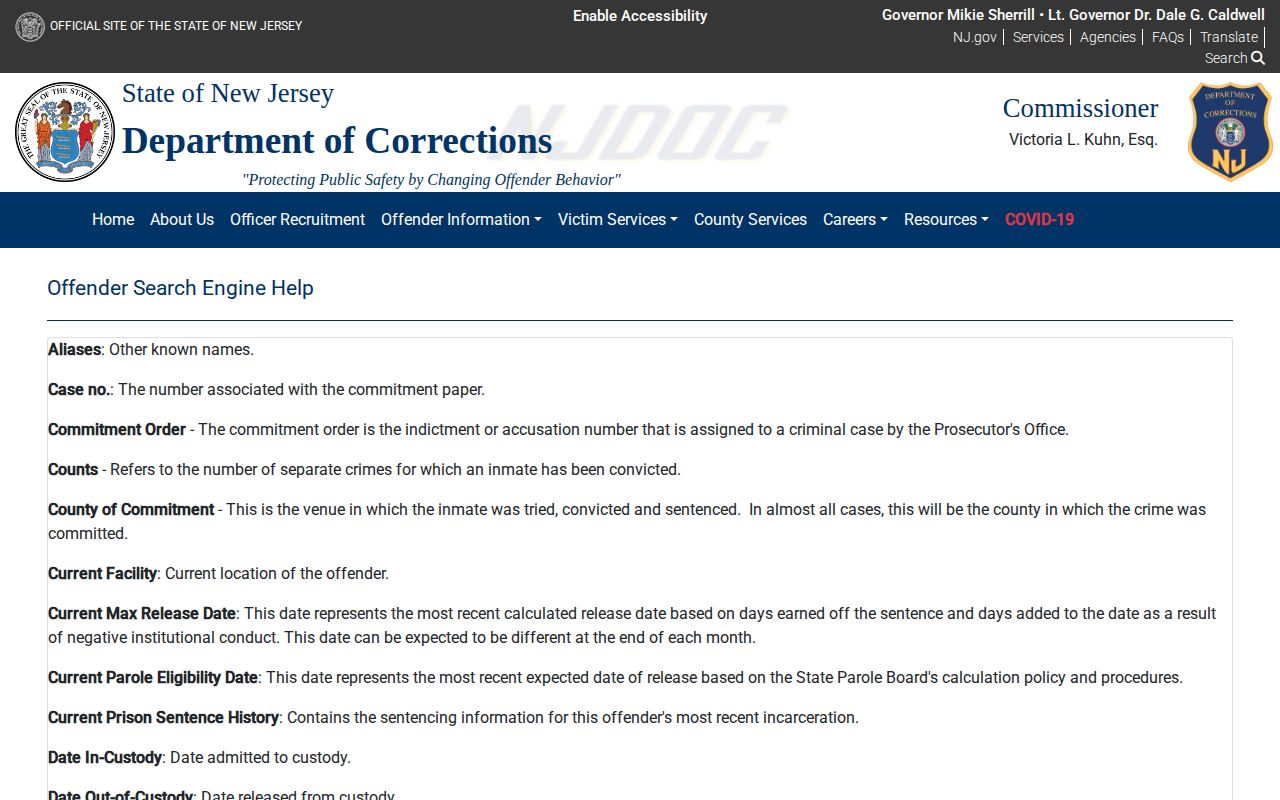
The glossary helps prevent a future maximum date or parole eligibility date from being reported as an actual Sussex County release.
Sussex County NERA Release Dates
The No Early Release Act, N.J.S.A. 2C:43-7.2, is not a universal rule that every New Jersey inmate serves 85 percent. It applies to a first- or second-degree violent crime as defined by the statute when the court imposes the required minimum. The person is not parole eligible during that 85 percent minimum. Credits cannot create eligibility before a controlling statutory or judicial minimum.
NERA also provides post-incarceration parole supervision, generally five years for a first-degree sentence and three years for a second-degree sentence, subject to the statutory lifetime-supervision exception. The confinement portion can therefore end while legal supervision continues. The actual sentence and offense provision must be checked before applying the rule.
N.J.S.A. 30:4-123.51 supplies the general parole eligibility framework, but mandatory minimums, NERA, multiple sentences, life terms, and older-code cases complicate it. A public Sussex notice can show jail credit, sentence, minimum notation, present location, and offense data, yet it still does not prove a grant. Use the later NJDOC record and final SPB action.
A parole grant also does not settle the actual gate date. The Board can impose conditions and schedule release, while NJDOC still completes its process. If adverse information arises, release can be rescinded. After departure, supervision may continue for the term set by law and the order. The confinement end, first parole report, and final discharge belong on separate lines of the timeline.