
Sussex County Released Inmate Records
“Released” describes the end of one custody event. It does not always mean that a person walked into the community with no legal limits. A Sussex commitment may end through bond or pretrial release, time served, dismissal, probation, parole, transfer to the New Jersey Department of Corrections, transfer to another county, federal custody, or an immigration hold. The release or movement record should keep the agency's exact label. That wording identifies the next place to check.
The local custody map is unusual. Keogh-Dwyer Correctional Facility remains the Sussex Bureau of Corrections command and transport base, but all Sussex adult inmates have been housed at Morris County Correctional Facility since the shared-services agreement took effect in fall 2019. Morris holds the person. Sussex retains records tied to the commitment and transport, while the Morris/Sussex court keeps the case disposition. A thorough Sussex County released inmate search may therefore require records from both counties.
- Discharge
- The recorded end of a custody or supervision term.
- Time served
- A sentence credited against time the person already spent in custody.
- Parole
- Release from prison while the State Parole Board still supervises the person.
- Probation
- Community supervision imposed by a court, often without a state-prison release.
How Sussex County Custody Ends
Each exit type points to a different record. The jail movement entry is strongest for the physical departure. The court order explains the legal reason. A locator or VINE alert can show what another agency reported, but it may update after the person left. Compare dates without forcing them into one timestamp.
| Recorded outcome | Meaning | Next source |
|---|---|---|
| Bond or pretrial release | County detention ends while the case continues | MCCF movement record and Sussex court docket |
| Time served or dismissal | The listed case no longer supports detention | Court judgment plus the jail exit record |
| Probation | The court imposes community supervision | PROMIS/Gavel and the signed order |
| Parole | Prison custody ends under SPB supervision | NJDOC custody history and SPB records |
| Transfer | One custodian releases the person to another | NJDOC, BOP, USMS, ICE, or the receiving county |
A dismissal, acquittal, or release order may concern only one case. Another detainer can still control. Likewise, a VINE “release” can mark a handoff from Morris custody to a state, federal, or immigration agency. Use “released to the community” only when the recorded disposition supports that result.
Fields in Sussex Release Records
A focused record request should tie the person to a specific booking episode. Identifiers reduce the chance of mixing people with similar names. Ask for existing records, not for staff to write a new account of what happened. Booking photographs may be kept apart from movement records and should be requested separately.
| Field | What it shows |
|---|---|
| Full name and aliases | The identity used in the custody episode |
| Booking or SBI number | A reliable link between records and systems |
| Admission date and agency | When the episode began and who brought the person in |
| Charge or complaint identifier | The court matter connected with custody |
| Release date and time | The jail's recorded administrative exit |
| Release type or destination | Whether the exit was to the community or another custodian |
| Booking photograph | The image associated with that booking, if disclosable |
No official public Sussex or MCCF recent-release archive was found, and no source states how long former detainees remain visible online. That gap must remain a gap. Request the relevant archived record or the agency's retention schedule instead of assuming a number of days.
Request Sussex County Release Records
Sussex Sheriff maintains commitment and transport material, while Morris County may hold the physical MCCF admission, movement, and release entries. A parallel request can be necessary. The Sussex custodian is at the Sheriff's Office, 39 High Street, Newton, and accepts the county's current OPRA form through the channels printed on it.
- Gather the full name, aliases, booking or SBI number, and an approximate booking date.
- Use the Sussex Sheriff OPRA form to identify the booking, commitment, movement, release, transfer, and photo records sought.
- Ask Morris County which MCCF records it maintains for the same Sussex commitment.
- Request electronic copies and ask the custodian to redact exempt portions rather than withhold a separable public record.
- Compare the response with the court disposition and any receiving-agency record.
New Jersey OPRA lists ordinary paper rates of $0.05 per letter-size page and $0.07 per legal-size page. Other media, delivery, and special services can carry actual costs. The general response benchmark is seven business days, though special categories, storage issues, and lawful extensions can change the period. The current form and statute control.
Sussex County Sheriff's Office OPRA Custodian39 High Street
Newton, NJ 07860
Fax: 973-579-7884
Email: OPRA@sussexcountysheriff.com
Sussex County Release Record Limits
The New Jersey Open Public Records Act, N.J.S.A. 47:1A-1 et seq., covers many paper, electronic, and image records kept by public agencies. It also preserves exemptions. Juvenile, sealed, expunged, investigative, privacy, safety, and security material may be withheld or redacted. Court files follow Court Rule 1:38 and Judiciary procedures, not county OPRA.
A dismissal is not an expungement. An expunged case leaves Judiciary public systems, and N.J.S.A. 2C:52-30 restricts knowing disclosure of expunged matters.
New Jersey Courts provides the official expungement process and eligibility guidance. A records custodian must apply the current law to the specific request. If an official result disappears after an order, do not use copied or cached material to defeat that legal change.
Find Sussex County Released Inmates
Begin with the last known custodian and use the strongest record for the question. A release order answers why detention should end. The movement record answers when the jail processed the departure and where the person went. A live locator answers only what its participating agency reports now.
- Check New Jersey VINE by exact name or ID and confirm that MCCF or the expected agency reports the result.
- Call MCCF Records, then request the Sussex and Morris movement or release documents.
- Review the Sussex criminal case for a dismissal, pretrial order, judgment, sentence, or probation term.
- If the record shows a state transfer, search NJDOC by SBI number or verified identity fields.
- Use BOP for a federal sentence, ICE ODLS for a qualifying immigration custody check, and the federal docket or USMS contact for pretrial federal custody.
A released person usually leaves a live jail view. Absence alone can also mean transfer, lag, a name mismatch, confidentiality, or an expired display.
What if the sources show different times? Keep each time with its source and meaning. A judge may sign an order first, MCCF may complete the physical movement later, and VINE may transmit its notice after that. Ask for the administrative release timestamp when the question concerns the actual departure. Use the signed order when the question concerns the legal basis. One time should not replace the others unless an official record connects them.
A past release needs a different method than a same-day event. Live systems are weakest months or years later. Seek the archived Morris movement record and Sussex commitment record, then compare the court judgment. For state custody, NJDOC incarceration history can preserve the episode. BOP covers federal records from 1982 forward. VINE and the limited ICE recent-release display are not permanent archives.
For a focused same-day check, the Sussex County 24-Hour Releases page lays out the phone, VINE, court, and request fallback. There is no official rolling feed to substitute for those sources.
Sussex Released Inmate Offender Search
The NJDOC Offender Search applies after a person enters New Jersey state prison custody. It is not a complete Sussex county-jail history. Search by SBI number when possible. A name search requires careful comparison of aliases, physical details, county of commitment, sentence data, and dates.
| NJDOC field | How to read it |
|---|---|
| County of Commitment | Case venue, not the current prison location |
| Current Facility | The reported present NJDOC placement |
| Date In-Custody | Admission into the listed custody period |
| Date Out-of-Custody | The key retrospective state-custody exit field |
| Current Max Release Date | A changing calculated maximum endpoint |
| Current Parole Eligibility Date | The current date calculated under SPB policies |
The official NJDOC field glossary explains the date labels shown below.
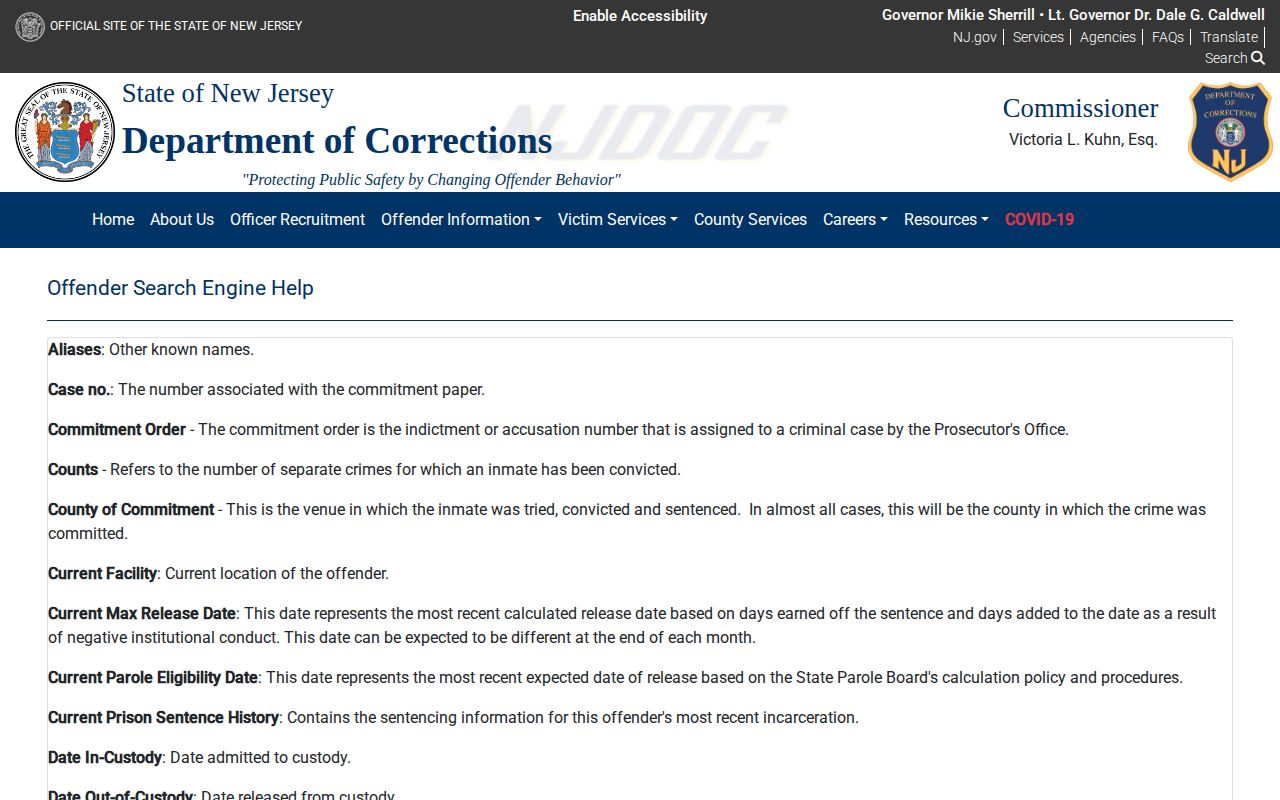
The glossary matters because a future maximum or eligibility date does not prove that release occurred. Look for Date Out-of-Custody and incarceration history when confirming a past state exit.
Sussex Release Records in Two Cities
The durable criminal case record remains in Newton, but adult physical detention occurs in Morristown. The Sussex County Judicial Center and Criminal Records Room can supply the disposition under Judiciary rules. Sussex and Morris corrections supply movement and release records. The split explains why one office rarely answers every part of a release question.
PROMIS/Gavel public access may show charges, case status, disposition, judgment, and sentence entries. It does not normally give the precise time the person crossed the jail door. A judge may enter an order before jail staff finish processing, and another detainer may delay or redirect the exit.
Sussex Release Reentry at MCCF
The Morris Reentry Program serves people at the actual facility housing Sussex inmates. It offers individual transition planning, help coordinating identification and documents, service connections, and continued case management after release. A Sussex detainee can ask for planning before the custody record changes.
Coordinator Antonella McGee is listed at 973-631-5036. That contact supports transition planning; it does not replace MCCF Records for proof of release. The agency movement record and court order remain the sources for custody status and legal disposition.
Sussex Release Property and Identification
MCCF says accumulated property may be mailed out at the inmate's expense or picked up by a friend or relative, by request, on a scheduled visiting day. That is a during-custody option. No official source found a post-release walk-up property procedure, so callers should confirm a specific authorized pickup with MCCF.
Reentry staff also help prepare documents and identification before release. These tasks can reduce delays after custody ends, but they do not establish the release date. Preserve the discharge papers and follow the reporting instructions printed on them when parole or another form of supervision follows.
Getting Home After Sussex Release
Physical adult releases take place in Morris County, so Sussex Skylands Ride is not a verified jail-gate service. Once a person reaches the Sussex service area, the county's public loop runs Monday through Friday from 5:30 a.m. to 6:30 p.m. The stated one-way fare is $1 exact, and a route deviation generally needs 48 hours of advance contact.
The Sussex Skylands Ride fare page gives the current rules and service contact. Release time, exit location, weekend practice, and pickup area were not published by MCCF. Ask facility staff about the specific discharge before arranging a ride.
Payments and Sussex Release Alternatives
MCCF states that accepted bail, fine, fee, and probation payments must be made by cash, money order, or cashier's check. Payment acceptance is not proof that the person left. The court order, unresolved holds, and jail processing still govern the custody result.
Sussex Home Detention and the Sheriff's Labor Assistance Program can place eligible sentenced participants outside a cell under GPS or work supervision. Neither is a full discharge. Home Detention is a supervised custodial sentence, and a SLAP violation may lead to revocation and return to jail. Use the court order and program paperwork to identify the status precisely.
Sussex Release Alerts and Transfers
New Jersey VINE offers live custody information and notification registration while a matching person is in searchable custody. Select New Jersey, compare the identifiers and reporting agency, then register each desired delivery channel separately. A phone registration uses a four-digit PIN. An alert is timely evidence of what the agency reported, not the full discharge record.
Federal systems remain distinct. BOP's locator can show a release date or “Not in BOP Custody” for federal sentenced custody. USMS has no comparable public person locator for federal pretrial detainees. ICE ODLS covers current detainees and some people released from ICE custody within its stated 60-day period. None of those results proves freedom from every other custody or supervision system.
Where Sussex Release Status Appears
Choose a system by custody type, not merely by the county named in the case. “County of Commitment: Sussex” on an NJDOC record does not mean the person is still in Sussex. The table separates live custody from a past exit record.
| System | Best use | Key limit |
|---|---|---|
| MCCF Records | Physical adult county housing and movement | A departure may be a transfer |
| Sussex Sheriff OPRA | Sussex commitment and transport records | May not contain every Morris movement field |
| NJDOC | State custody and Date Out-of-Custody | Not a county-jail archive |
| VINE | Current status and custody-change alerts | Not a permanent historical archive |
| PROMIS/Gavel | Legal disposition and sentence | Not the exact jail exit timestamp |
| BOP or ICE | Federal or immigration custody | An exit may lead to another authority |
Probation and parole need separate proof. Probation appears through the judgment or order; parole begins after prison custody and is handled by the New Jersey State Parole Board. The Sussex County Post-Release Supervision page explains those checks and the local reentry path.
Sussex County Release Facilities
The custody chain can cross several agencies. The first three links cover Sussex administration, physical adult housing, and confidential regional youth detention. The remaining pages explain state, federal, Marshals, and immigration paths that can follow a Sussex custody exit.
- Keogh-Dwyer Correctional Facility, the Sussex command and transport base.
- Morris County Correctional Facility, the physical adult housing and release site.
- Morris County Juvenile Detention Center, where authorized juvenile channels apply.
- New Jersey Department of Corrections facilities, for state prison custody and discharge.
- Federal Bureau of Prisons system, for sentenced federal custody.
- U.S. Marshals Service contract custody, for federal pretrial and presentence movement.
- U.S. Immigration and Customs Enforcement custody, for immigration detention and limited recent-release checks.
A juvenile name, photograph, placement, or release detail is generally confidential. Authorized family members and counsel should use the Family Division, juvenile services, and facility contacts rather than adult public-search methods.